The story behind Sifty AI
A product built from a real problem — the endless clutter in our phone galleries — and the belief that AI can solve it thoughtfully.
We all have thousands of photos we'll never look at again
I had over 8,000 photos on my phone. Screenshots of things I'd already dealt with. Food photos I'd never look at again. Dozens of nearly identical shots from the same moment. Images that made sense at the time but were digital clutter months later. And I'm not unusual — every friend or family member I talked to described the same experience.
The result? Storage warnings, slow backups, and a gallery where real memories were buried under noise. I tried existing gallery cleaners and duplicate finders, but they all had the same problem: they made deletion slightly easier without reducing the cognitive load of deciding what to keep. The real bottleneck was never the delete button — it was the 8,000 decisions required to reach it.
That's the gap Sifty was built to fill.
From insight to product
Identifying the pain point
It started with my own phone — 8,000+ photos accumulated over nearly a decade, and zero motivation to sort through them. Conversations with friends and family confirmed this wasn't just my problem. Everyone's gallery was a mess, and nobody had a good solution.
Why not let AI decide?
The key insight: photo sorting isn't one-size-fits-all. A photo of food might be trash for one person but a cherished memory for a food blogger. The AI needs to learn individual preferences, not apply generic rules.
The learning and cleaning model
Designed a streamlined learning system: the AI first learns your preferences through interactive review (Learning), then sorts the rest of your gallery with high confidence (Cleaning). Each phase reduces user effort while increasing AI accuracy.
User Story + Master Context
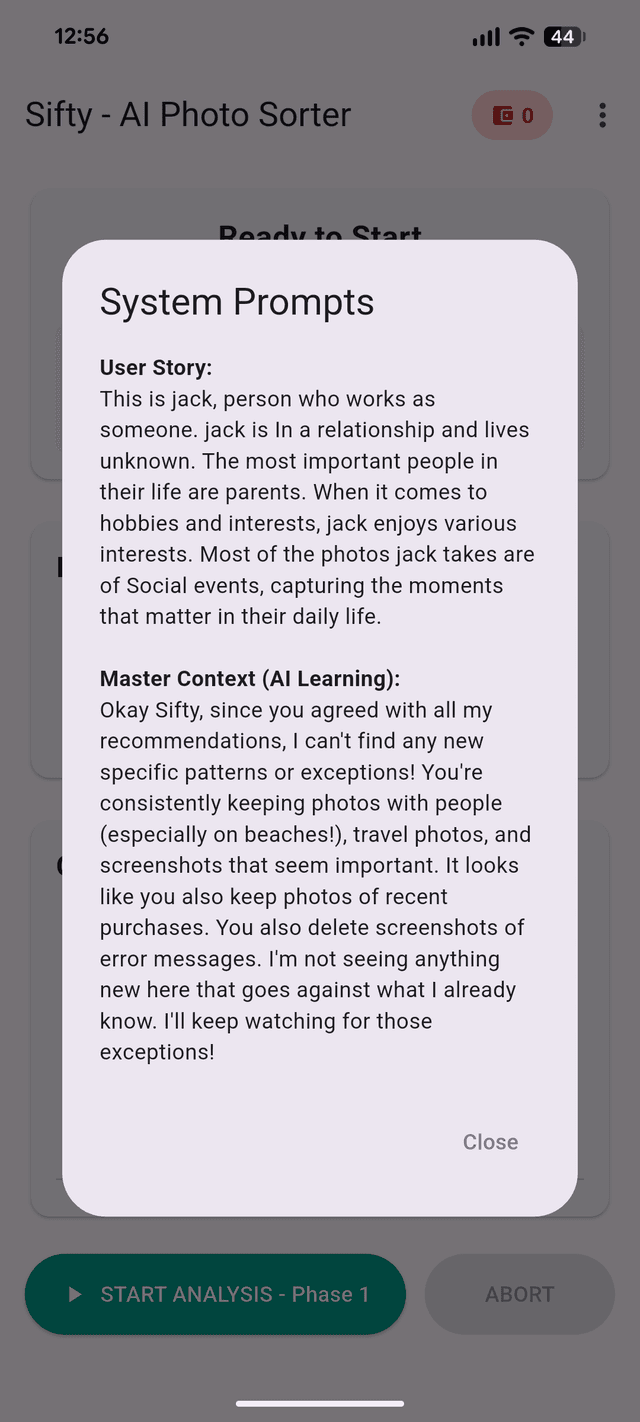
Built the AI to maintain two knowledge structures: a User Story (who you are, what you care about) and a Master Context (specific patterns learned from your decisions). Together, they create personalized photo intelligence.
Keyword search emerges from analysis infrastructure
While building the AI analysis pipeline, a realization: the rich descriptions generated for scoring could power a standalone keyword search feature. A byproduct of the core system became a major differentiator — search your gallery by describing what you're looking for.
Launch on Android & iOS
Shipped on both platforms with a focus on trust: safe trash bin, clear AI reasoning for every recommendation, and full user control. The AI suggests, but you always decide.
Product principles that shaped Sifty
Trust through transparency
Every AI recommendation comes with a reason. Users can see exactly why Sifty suggests deleting a photo. No black box decisions on your personal memories.
Progressive disclosure
Rather than overwhelming users with settings, Sifty learns through interaction. The system gradually builds accuracy without demanding upfront configuration.
Safety by default
Nothing is permanently deleted without explicit confirmation. The trash bin creates a safety net that gives users confidence to make faster decisions.
Minimal friction
Swipe or tap to decide. No complex UI, no learning curve. The interaction model was designed to feel as natural as scrolling through a social feed.
AI that adapts, not dictates
Sifty's AI maintains a living profile of your preferences. It tracks patterns like “keeps photos with people, especially on beaches” and “deletes error screenshots” — then applies these learned rules with increasing confidence.
When the AI encounters something new, it flags it for review rather than making assumptions. This human-in-the-loop approach ensures the AI earns trust gradually rather than demanding it upfront.
Experience the product
See these product principles in action. Download Sifty AI and let the AI learn what matters to you.
Download Sifty AI